How to Choose the Right Paper for Cyanotype and Alternative Printing

Choosing the correct paper is critical in alternative photography. It's the soul of your print. For cyanotypes, not all papers are created equal.
Criteria for a good paper
- 100% Cotton or pure Cellulose: Avoid cheap drafting papers. Cotton holds up perfectly during the long wash cycles necessary in alternative processes.
- Sizing: A paper with too much internal or external sizing will prevent the chemistry from soaking in properly. A paper with no sizing will absorb everything, leading to a flat, low-contrast print.
- Zero tolerance for Optical Brightening Agents (OBAs): These bleaching chemicals react poorly to the iron salts in cyanotype, often causing premature fading or yellowing.
Our Recommendations
The ideal paper for starting out is the Bergger COT 320, or a hot/cold pressed Arches watercolor paper. Make sure you use at least 300gsm paper so it doesn't buckle and disintegrate in your washing tray.
Summary table: choosing your paper
| Criterion | Recommendation | Why |
|---|---|---|
| Paper weight | 300 gsm minimum; 640 gsm as the Vision Picturale standard, essential for large formats. | Below 300 gsm, the sheet buckles and disintegrates in the tray during the 5-minute rinse in running water, and the print becomes hard to handle. At 640 gsm, the sheet stays flat from the tray through rack drying (2 to 4 hours). It is the paper supplied in the VP cyanotype kit: 10 A4 sheets of 640 gsm 100% cotton watercolor paper. |
| Fiber: 100% cotton | 100% cotton watercolor paper, such as Bergger COT 320 (100% cotton, OBA-free, 320 gsm) or Arches. | Cotton withstands the prolonged washes typical of alternative processes, where cheap cellulose warps and falls apart. Drawing papers and budget pads handle water rinses poorly: they are the leading cause of prints lost at the washing stage. |
| Sizing | Medium, balanced sizing — that of quality watercolor papers like Arches. For Aquaprint (gum), specific sizing applies: the sheet is scalded, then coated with 4 layers of transparent gesso. | Over-sized (very smooth), the chemistry cannot soak in: pale print. Under-sized, the paper drinks all the chemistry: flat, low-contrast result. Medium sizing lets the chemistry penetrate the surface without being fully absorbed — this is where Prussian blue contrast is won or lost. |
| Optical brightening agents (OBAs) | Zero brighteners: paper explicitly guaranteed OBA-free. Simple test: OBA-free paper does not glow blue under a UV lamp. | Brighteners are fluorescent whitening agents that react poorly with the iron salts of cyanotype: premature yellowing and loss of contrast. Without OBAs, the highlights do not yellow over the decades — the condition for cyanotype's archival permanence of roughly 100 to 150 years. Papers in the VP selection are guaranteed OBA-free. |
| Texture (grain) | Fine grain to start (fine-grain Arches); a heavier grain remains possible for a more textured look. | The paper's white forms the whites of the image: during rinsing, unexposed areas dissolve and reveal the bare paper. A neutral white preserves the purity of Prussian blue, and the grain contributes to the print's unique character. Whatever relief you choose, negative-to-paper contact must remain perfect under the glass plate during exposure. |
Common paper mistakes (and how to spot them)
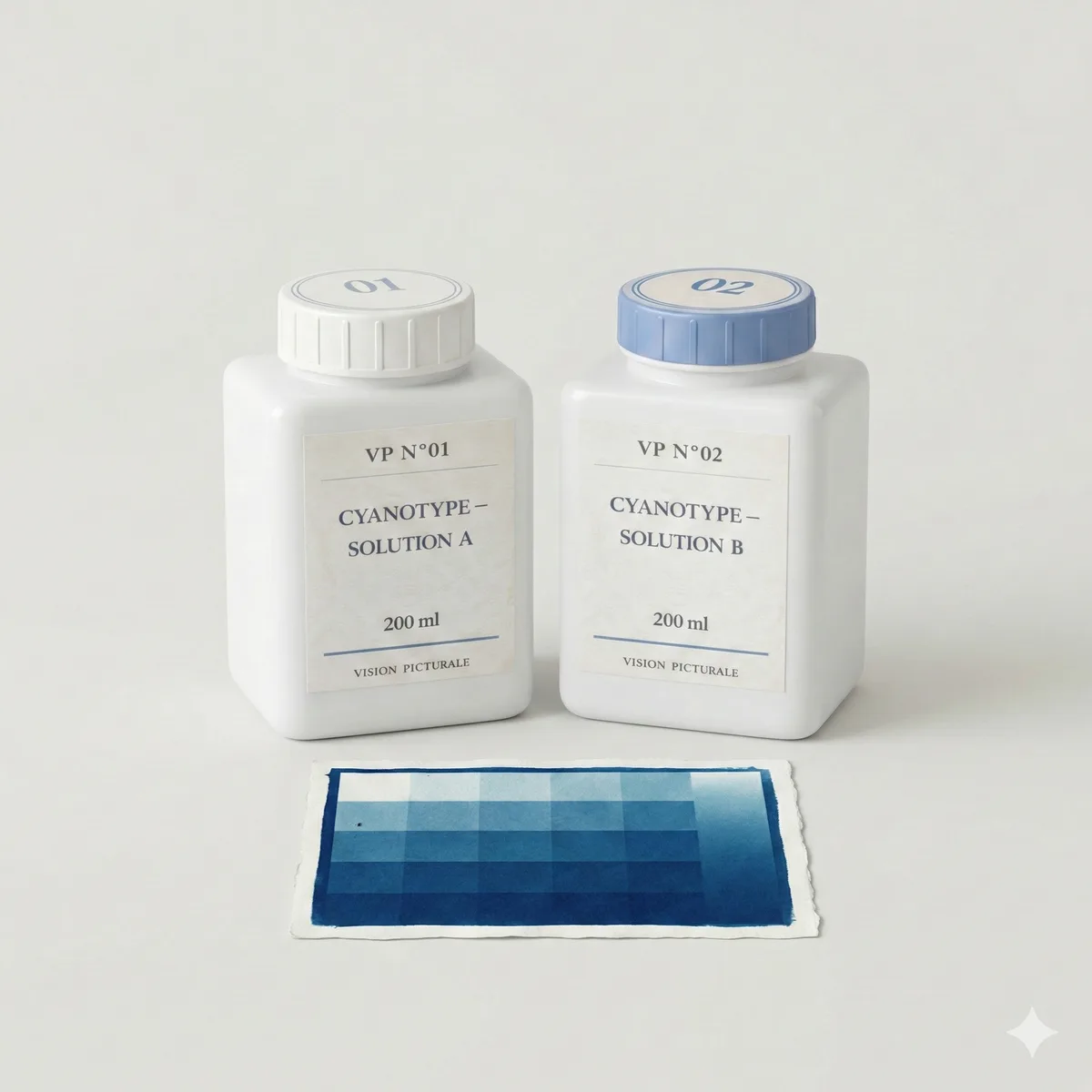
Nearly every cyanotype that fails "for no apparent reason" comes down to the paper, not the chemistry. VP N°01 and VP N°02, mixed in equal parts, behave very predictably; the support is what introduces the variables. Here are the five mistakes we see most often, with the symptom that gives each one away.
The diagnosis can almost always be read on the print itself: a sheet that ripples in the tray points to the weight, a pale or flat print points to the sizing, whites drifting toward yellow point to brighteners. Before changing your chemistry, change your paper — and reprint the same negative to compare.
- Going below 300 gsm: the sheet buckles in the rinsing tray, disintegrates at the edges and becomes impossible to handle flat. At 640 gsm, the problem disappears.
- Ignoring optical brighteners: premature yellowing of the highlights and loss of contrast on contact with iron salts. Check under a UV lamp: a sound paper shows no blue fluorescence.
- Getting the sizing wrong: pale print = over-sized paper, the chemistry stays on the surface; flat, low-contrast print = under-sized paper that absorbed everything.
- Using drawing paper or a budget pad: these papers are not built for the prolonged washes of alternative processes and break down during rinsing.
- Carrying the Aquaprint preparation over to cyanotype: scalding the sheet and applying 4 coats of transparent gesso belong to gum printing. For cyanotype, the cotton sheet is coated directly by brush, in dim light.
- Cutting the rinse short: allow 5 minutes in running water, until the water runs clear and the unexposed areas return to white.
What a good paper changes in the print
In cyanotype, the paper is not a passive support: it provides the whites of the image. During rinsing, the areas protected by the negative dissolve away and reveal the bare paper; a neutral, brightener-free white preserves the purity of Prussian blue — and the blue keeps deepening as it dries. On a paper yellowed by OBAs, that white/blue contrast, the whole strength of the process, collapses.
Contrast is decided by the sizing. When the chemistry penetrates the surface without being fully absorbed, the shadows build density and the whites stay clean. That is exactly what a 100% cotton watercolor paper with balanced sizing delivers, and what no exposure adjustment can recover on a poor support.
Physical strength, finally, determines how comfortably you work. A 640 gsm sheet stays rigorously flat from sensitization (5 minutes by brush for an A4 sheet, then 20 to 30 minutes of dark drying depending on ambient humidity) through to final rack drying, 2 to 4 hours. That is what lets you calmly complete 3 to 4 prints in a single morning by parallelizing exposure and rinsing.
Over the long term, the right paper is the condition of permanence: a cyanotype on brightener-free cotton, kept away from direct light and mounted on pH-neutral board, lasts roughly 100 to 150 years.
Beyond the sheet: fabric, linen, wood
Cyanotype is not limited to paper: any absorbent support works. Cotton fabric, linen canvas, raw wood — the VP N°01 + N°02 emulsion is brushed on in exactly the same way, with the same nitrile gloves to avoid lasting stains on the skin.
To get started, the Vision Picturale cyanotype kit includes 10 A4 sheets of 640 gsm 100% cotton watercolor paper, matched to enough emulsion for roughly 30 A4 prints; paper refills are available separately from the shop.