Is Cyanotype Toxic or Dangerous? The Honest Answer, Safety Data Sheets in Hand

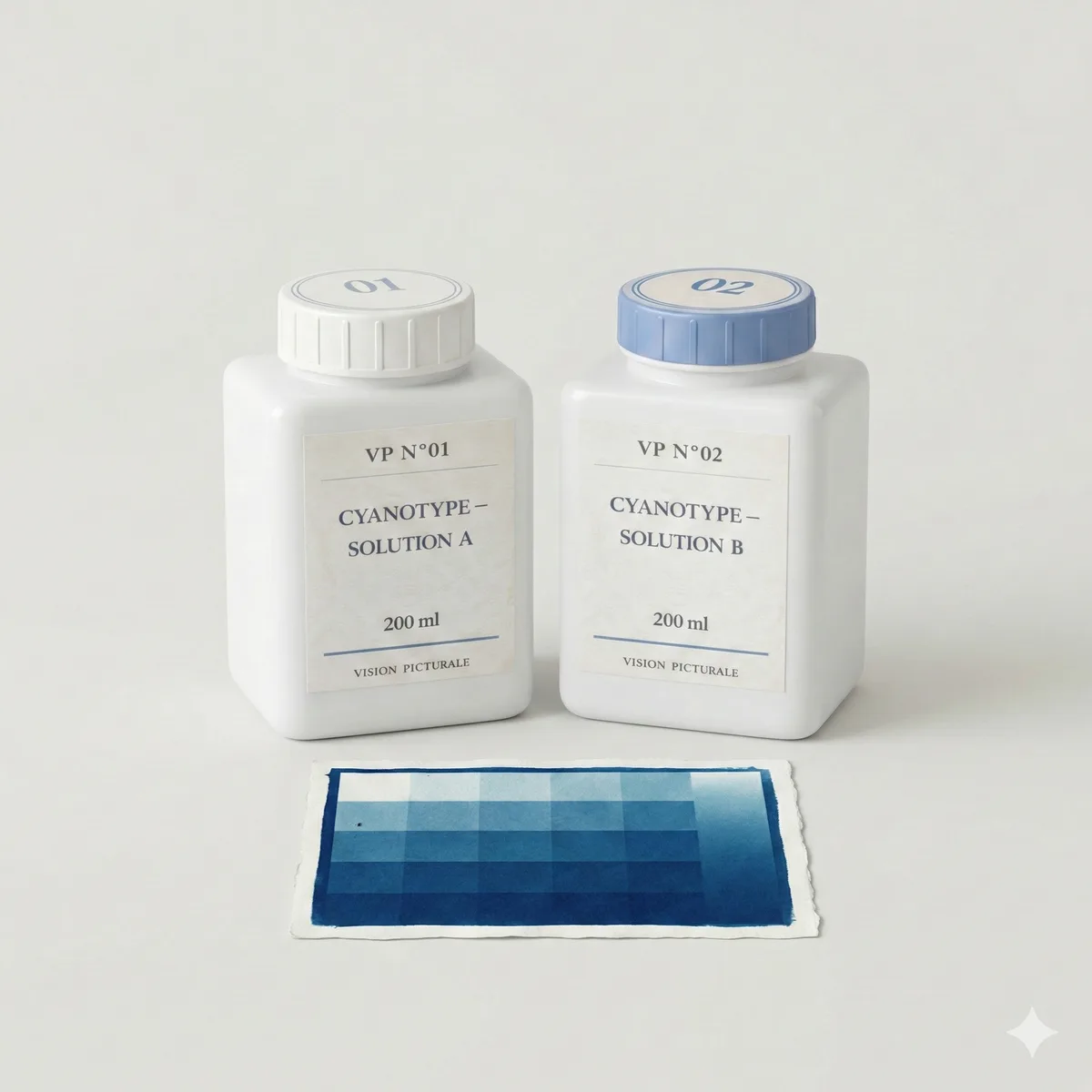
Cyanotype chemistry relies on two iron salts: ferric ammonium citrate (VP N°01 in the Vision Picturale nomenclature) and potassium ferricyanide (VP N°02), mixed in equal parts. Invented by Sir John Herschel in 1842 and popularized from 1843 by botanist Anna Atkins, the process exploits the photosensitivity of this mixture: under UV-A light, iron III reduces to iron II and forms Prussian blue, an insoluble pigment. This chemistry contains no silver salts, no dichromate, and no volatile solvents — and the print requires no chemical fixer at all.
What cyanotype chemistry actually contains — and how it is classified
On the classification side, ferric ammonium citrate carries no health hazard pictogram on European safety data sheets. Potassium ferricyanide, meanwhile, feeds a stubborn confusion because of its name: unlike free cyanide, it only releases cyanide in the presence of hot strong acids — conditions that never occur during a print. On the scale of the European CLP regulation, cyanotype chemistry therefore sits at the opposite end from the historical hexavalent chromium sensitizers, which are classified CMR.
In practice, the Vision Picturale cyanotype kit (Coffret Bleu Iconique, 39 euros) supplies both solutions pre-dosed, to be brushed onto 100% cotton, 640 gsm watercolor paper free of optical brighteners. One set of VP N°01 + VP N°02 bottles covers roughly thirty A4 prints. After exposure, development amounts to five minutes of rinsing in running water — no developer bath, no fixer, no neutralizer.
The real precautions — honest, and exactly two of them
The first real precaution concerns your skin: the sensitizing solution causes lasting stains. Wearing nitrile gloves during brush coating is therefore recommended — not against systemic toxicity, but against stubborn marks on your fingers. The logic is the same as for a dye or an ink: you are protecting yourself from staining, not from poison. Covering the worktable with polyethylene film completes the setup.
The second precaution is the process's only strict chemical rule: never mix the baths or solutions with concentrated acidic household products. It is only under those extreme conditions — hot, strong acids — that potassium ferricyanide can release cyanide. In the normal course of a print (coating, drying, exposure, rinsing in plain water), that situation simply never arises.
Everything else is workspace comfort rather than safety: store the bottles at room temperature away from light, work in a dimly lit room — the chemistry is sensitive to UV only, not visible light, so an incandescent bulb is fine — and rinse in a household sink. No mask, no extraction hood, no respiratory protection: the chemistry releases no volatile solvents.
The real danger in old processes: dichromate, not cyanotype
Cyanotype holds a singular place in the history of alternative processes: it was already low in toxicity from the very start. The Vision Picturale kit uses the same two iron salts as Herschel's formula — the studio's non-toxic reformulation work targeted the other processes, not this one. Cyanotype never needed to be detoxified: it has always been the safest gateway into alternative photography.
The contrast with historical pigment processes is stark. Gum bichromate, practiced with potassium dichromate since 1858, relies on a hexavalent chromium salt classified CMR category 1B (carcinogenic, mutagenic) by the European Chemicals Agency. Historical bromoil bleached its matrices with cupric dichromate, also classified CMR. The resinotype of the 1920s combined dichromate with volatile solvents. Dichromate is the shared toxic point of historical gum, carbon, bromoil, and resinotype. Cyanotype, unlike Van Dyke brown, does not contain silver nitrate either.
Those processes demanded a ventilated studio, protective equipment, and regulated effluent disposal — nothing comparable to rinsing a cyanotype under tap water. It is precisely for them that Vision Picturale developed the VP N°03 Universal Sensitizer, which replaces dichromate in Aquaprint, VP bromoil, and VP carbon. When people search for "cyanotype danger", they often project onto it the reputation of its chromium cousins — a reputation it never deserved.
Kitchen practice, children in the room: what the process really allows
Yes, cyanotype can be practiced in a kitchen — that is the exact setting the Vision Picturale kit is designed for: a table covered with polyethylene film for coating, a household sink for rinsing, bottles stored at room temperature away from light. No darkroom is needed: since the chemistry is only sensitive to UV, a room dimly lit by an incandescent bulb is enough for coating. No extraction hood either — every VP process is designed to work without one.
With children in the room? The chemistry contains no volatile solvents and no CMR substances, and the spectacular steps — the image turning grey-bronze during exposure, the blue revealing itself in the rinse — are precisely the ones meant to be watched. The common-sense rule is the same as for any household product: measuring, mixing, and coating remain adult gestures, nitrile gloves on, bottles closed after use. Cyanotype is a process you can pass on — not a toy.
Disposing of the baths: what happens to cyanotype rinse water
Cyanotype produces no development bath in the usual sense: development is the rinse. The exposed sheet spends five minutes under running water, until the water runs clear and unexposed areas return to white. That rinse water goes down the household sink with no special precaution — this is the documented protocol of the VP kit. Unused chemistry keeps in its original bottles, at room temperature and away from light.
One prohibition, always the same: never combine those waters with concentrated acidic household products, the only configuration in which ferricyanide could release cyanide. To measure the distance from real hazard handling: historical gum bichromate required regulated disposal of its hexavalent chromium effluents. Cyanotype ends where it began — in a kitchen, in plain water.
Further reading: cyanotype · kit cyanotype · comment faire son premier cyanotype · lexique